Every January you write the same list: get fit, save money, read more. The first week goes well. By February the list is in a drawer, and you are already planning to try again next year.
The list was fine. What was missing is the normal-Tuesday part: what exactly you do, and what happens when you skip it.
Why most resolutions fade
Resolutions work better than their reputation. In a 2002 study, Norcross and colleagues followed 159 people with New Year's resolutions: after six months, 46% were still succeeding, against 4% of people who wanted to change but made no resolution. A 2020 study of over 1,000 Swedish adults found 55% considered themselves successful a year later. Both rely on self-reports, so treat the numbers as rough.
The studies point to a few differences. In the Swedish study, resolutions framed as starting something (for example, "walk three times a week") succeeded more often than ones framed as stopping something (for example, "stop eating sweets"). In Norcross's study, successful resolvers leaned more on practical behavior-change steps. In our view, a vague outcome gives you nothing to do on day three; a small action does.
36 New Year's resolution ideas for 2027
Each idea comes with an action you can start this week. Change the numbers, keep the action concrete, and pick one to three, not six.
Health and fitness
- Get stronger: two 20-minute strength sessions a week
- Run a 5K: three short runs a week, one minute longer each week
- Sleep better: the same wake-up time every weekday
- Drink less alcohol: alcohol-free weekdays
- Eat more fruit: one piece with breakfast
- Sit less: take the stairs at least once a day
Mind and mood
- Scroll less: social apps off the home screen, opened only after lunch
- Be more present: phone-free dinners
- Get outside more: one long walk in a park every weekend
- Be kinder to yourself: every Friday, write down one thing that went well
- Clear your head at night: put tomorrow's worries on paper before bed
- Pick up a hobby: one class or session a week
Focus and work
- Procrastinate less: 15 minutes on the hardest task before anything else
- Do deeper work: two phone-free hours, two mornings a week
- Protect your time: one meeting-free afternoon a week
- Finish a side project: one hour every Saturday morning
- Tame your inbox: clear it to zero every Friday
- Leave work at work: work apps closed after 7 p.m.
Money
- Build a savings buffer: an automatic transfer on payday
- Cut forgotten subscriptions: review one bank statement a month
- Pay down debt: one extra payment a month, however small
- Spend less on takeaway: pack lunch three days a week
- Buy less on impulse: wait 48 hours before any non-essential purchase
- Declutter for cash: list one unused item for sale each week
Relationships
- Call family more: one call every Sunday
- See friends more: one plan in the calendar every two weeks
- Keep a date night: one evening a week, phones away
- Never miss a birthday: add them all to your calendar in January, message on the day
- Make new friends: join one club or group and go weekly
- Listen better: ask one follow-up question before talking about yourself
Learning
- Read 12 books: one a month, 20 minutes at lunch
- Learn a language: one lesson each morning with your coffee
- Learn to cook: one new recipe every weekend
- Grow a work skill: one course module a week
- Write more: one page every Sunday
- Learn to draw: one 10-minute sketch a day
Want smaller daily habits instead of big resolutions? Our list of 40 habits to track groups them by goal, each with a yes-or-no check.
How to make a resolution stick
- Write it as a start, not a stop. "Pack lunch three days a week" instead of "stop buying takeaway". That framing did better in the Swedish study.
- Start smaller than feels useful. January is for repetitions, not results.
- Decide when and where. An if-then plan ("after breakfast, I walk ten minutes") takes the daily decision away. More in our steps to building discipline.
- Tell one person. In the Swedish study, the group with a support person and monthly check-ins did best; extra goal-setting instructions on top did not help.
- Never miss twice. One skipped day is noise; giving up because of it is the real failure. If a broken streak has ended a resolution before, read about streak anxiety.
Tracking resolutions in Taskoria
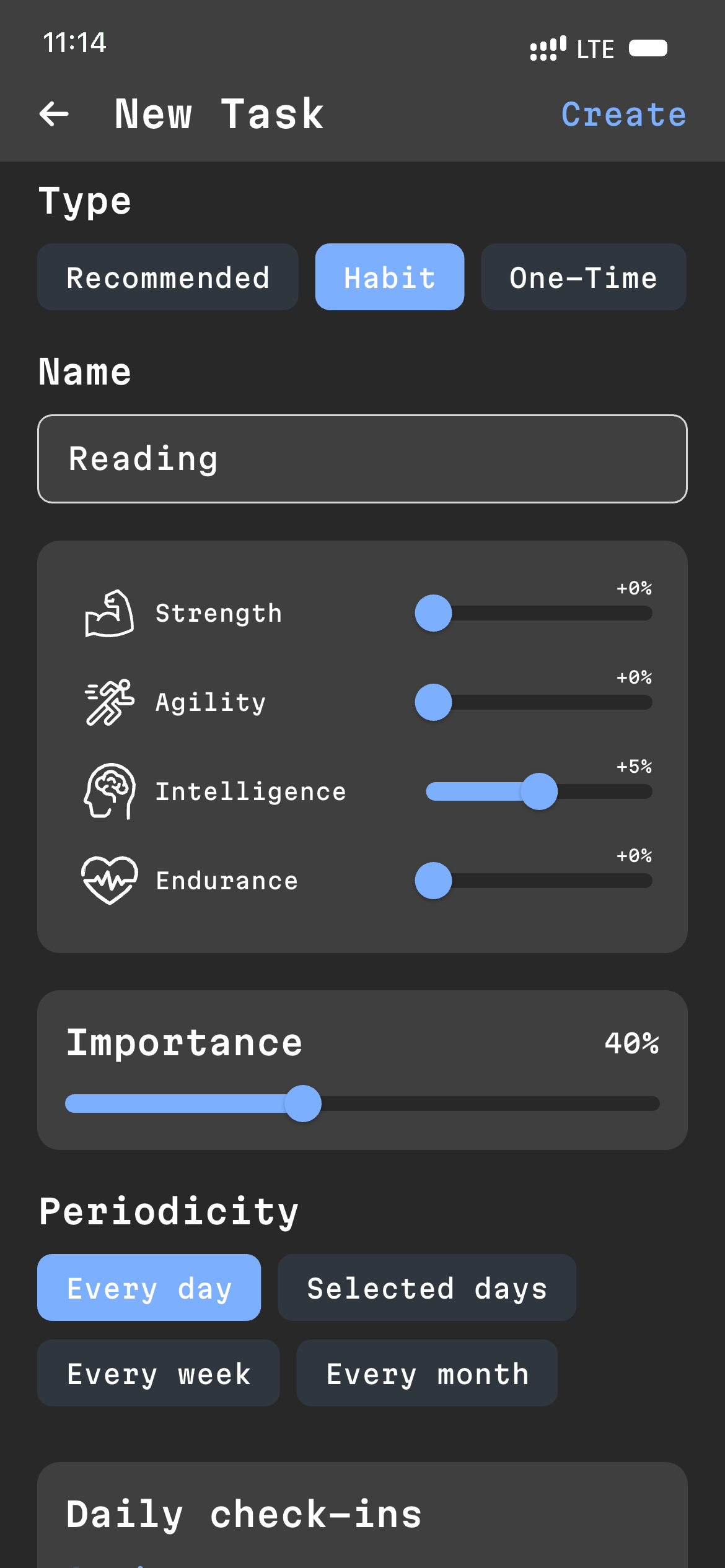
We build Taskoria, so weigh this with that in mind. Add the action behind each resolution as a task or habit: every one you complete deals damage to a monster, so a small rep in January still counts.
Miss a day and only the streak bonus resets. There is no HP loss, no death, and no lost levels or gear. Limits: there is no web app, and it tracks your actions rather than enforcing them. It's free on iOS and Android, with an optional subscription that adds Goals, real-life Skills and home-screen widgets. More in the player guide.
Frequently Asked Questions
What are good New Year's resolutions?
Ones you can turn into a specific action this week: two strength sessions instead of "get fit", an automatic transfer on payday instead of "save more". In one study, resolutions framed as starting something were kept more often than ones framed as quitting something.
How many New Year's resolutions should I make?
There is no research-backed number. We suggest one to three, so each one gets real attention in January. Add another once the first ones happen most weeks without much thought.
What percentage of people keep their New Year's resolutions?
In a 2002 study by Norcross and colleagues, 46% of resolvers were still succeeding after six months. In a 2020 Swedish study, 55% considered themselves successful after a year. Both rely on people reporting their own success.
Is there an app for New Year's resolutions?
Any habit tracker with daily tasks works. Taskoria is a habit RPG where each completed task deals damage to a monster and a missed day only resets the streak bonus. It is free on iOS and Android, with an optional subscription.
Try Taskoria free
Turn your 2027 resolutions into daily tasks that deal damage, and a missed day only resets the streak bonus. Free to download on iOS and Android.